
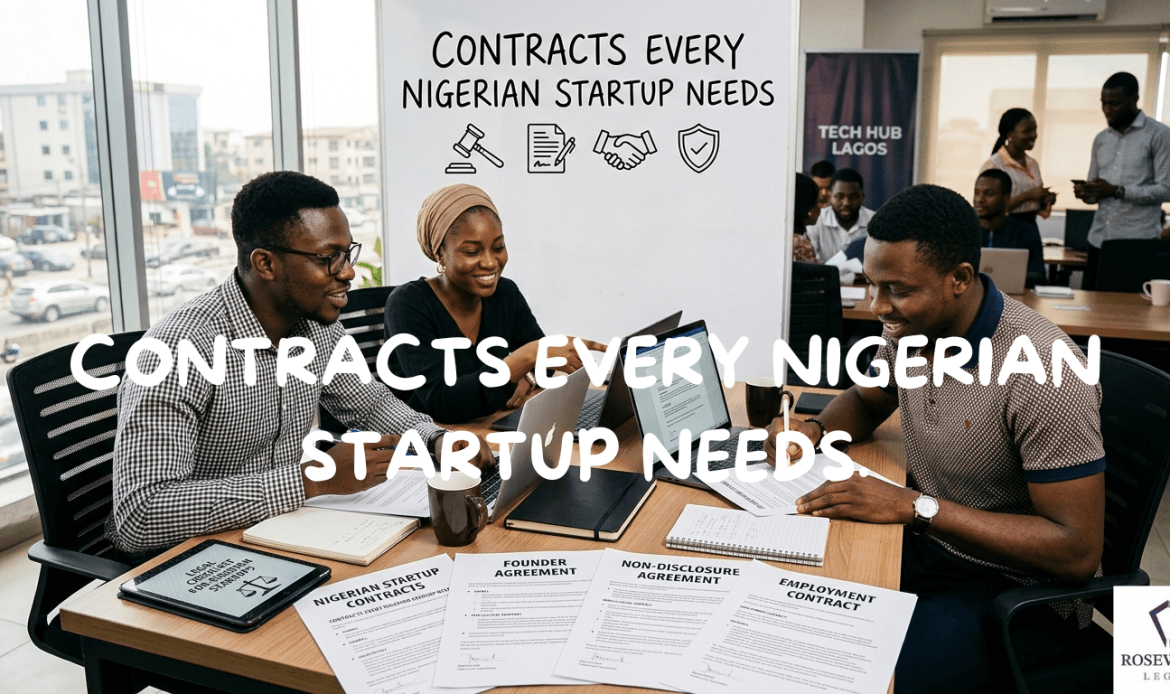
Introduction
Startups rarely stall because the idea was weak. They stall because co-founders fall out without agreed exit terms, developers claim ownership of the product they were paid to build, or investors uncover gaps in the company’s legal records during due diligence. These failures are costly, common, and, in most cases, avoidable.
The first article in this series addressed how to legally establish a startup in Nigeria. This article turns to the next question many early-stage founders face: which contracts should you put in place early to protect ownership, manage relationships, and keep the business investable before problems arise?
- The Founders’ Agreement
For any startup with two (2) or more co-founders, a founders’ agreement is the most important document the company will produce. If you are building with one or more co-founders, this is the document that should settle ownership percentages, roles and responsibilities, decision-making authority, vesting schedules, and exit provisions before disagreements begin. Without clear exit clauses, founders who depart early may retain equity stakes they no longer contribute to, a dispute that has derailed many promising Nigerian startups.
On vesting: while CAMA 2020 does not specifically provide for vesting agreements, a vesting arrangement that satisfies general Nigerian contract law is generally enforceable. Founders should note, however, that the memorandum and articles of association take legal precedence over private shareholder arrangements in the event of a conflict. Both documents should therefore be drafted together.
- Employment Contracts
Every staff member should have a written employment contract. For founders hiring even a small early team, this document should define roles, remuneration, termination procedures, confidentiality obligations, and, critically, ownership certainty over the work product the business depends on.
Under the Nigerian Copyright Act, where an employment contract is silent on ownership of copyright, ownership may, depending on the nature of the work and the surrounding circumstances, vest in the employee rather than the company. For any founder whose product depends on code, content, design, or other creative work produced by staff, this creates uncertainty in the company’s chain of title. The contract should therefore expressly assign relevant work product to the company. A legally compliant employment relationship is also grounded in the Nigerian Labour Act, which sets the baseline framework for terms and conditions of employment.
- Independent Contractor Agreements
Many startups engage developers, designers, and marketing consultants on a freelance basis. If your startup relies on outsourced talent at an early stage, these arrangements must be governed by a written independent contractor agreement, sometimes called a work-for-hire agreement. The agreement should cover the scope of work, deliverables, payment terms, confidentiality, and, most importantly, legal control over the core assets being created for the business.
Paying for software development does not automatically transfer ownership to the company. Without an express contractual assignment of rights, the contractor may retain legal ownership of the product on which the startup is built. This is one of the most common issues that undermines diligence readiness.
- Non-Disclosure Agreements
NDAs are appropriate when sharing business plans, financial projections, or proprietary data with potential investors, partners, or service providers. For founders who are still refining a product, speaking to advisers, or exploring commercial partnerships, an NDA can help define what information is confidential and how it may be used. In Nigeria, their enforceability generally depends on ordinary contract principles, the specific terms used, and the broader legal context, including the Labour Act, applicable intellectual property legislation, and the Evidence Act 2011.
One important limit applies: an NDA should not be drafted or interpreted in a way that prevents an employee from cooperating with a governmental authority in relation to a criminal matter or workplace offence. Founders should also avoid overusing NDAs. Demanding that every prospective investor or adviser sign one before an initial conversation can slow down legitimate engagement.
- Intellectual Property Assignment Agreements
A startup’s most valuable asset is usually its intellectual property. For many early-stage founders, that may mean code, brand assets, product designs, proprietary content, or other materials created before the company was fully structured. An IP assignment agreement formally transfers ownership of a specific right from an individual to the company. For investors, properly executed IP assignments help establish a clean chain of title and improve the company’s fundability.
Under Nigerian law, an IP assignment must be in writing and signed by the parties. Trademark and patent assignments require registration at the Trademarks, Patents, and Designs Registry; copyright assignments may be registered at the Nigerian Copyright Commission. Founders who developed core assets before incorporation should execute formal assignments in favour of the company as a priority.
- Investor-Facing Readiness
When an investor considers funding a startup, they conduct due diligence. For a founder raising capital for the first time, this usually means an investor will ask to review incorporation documents, statutory books, key commercial contracts, employment arrangements, and records that confirm the company’s ownership position over its core assets.
Investors are not looking for perfection. They are looking for evidence that the company is organized and that its rights are clearly documented. The agreements covered in this article form the core of what an investor will request. Building a well-organized document repository, commonly called a data room, from the earliest stages of the business improves transaction-readiness and builds the confidence needed to close a transaction.
Key Takeaways
Poor legal documentation is among the most common and most avoidable causes of startup failure. The agreements discussed in this article are not elaborate instruments reserved for established corporations. They are practical tools for managing the risks that arise when people, capital, and ideas come together without documented terms.
The best contracts are not the ones signed after a dispute. They are the ones that prevent the dispute from happening at all.
Founders should prioritize the founders’ agreement first, then put written employment and contractor agreements in place as the team grows and execute IP assignments for any pre-incorporation assets. Signed copies should then be stored in an organized document repository, so the business is ready for partnership discussions, fundraising, and future review. That approach to documentation signals to every investor, partner, and counterparty that the business is built to last.
Author

Talodabioluwa Iseoluwa Sanni
Trainee Associate
Rosewood Legal
Co-author

Lateefat Omotomilola Hakeem-Bakare
Principal Partner
Rosewood Legal
Published on Monday, June 8, 2026
References:
Companies and Allied Matters Act 2020.
Nigerian Copyright Act (Cap C28 LFN 2004).
Labour Act (Cap L1 LFN 2004).
Evidence Act 2011.
Oluwaseun Familusi, ‘Why You Badly Need A Founders’ Agreement For Your Startup’ (Mondaq, 12 February 2022) <https://www.mondaq.com/nigeria/executive-remuneration/898268/why-you-badly-need-a-founders39-agreement-for-your-startup> accessed 28 May 2026.
Oluwaseun Familusi, ‘Setting Up Your Start-Up: 9 Essential Agreements You Need’ (Mondaq, 2023) <https://www.mondaq.com/nigeria/contracts-and-commercial-law/1135646/setting-up-your-start-up-9-essential-agreements-you-need> accessed 28 May 2026.
Olisa Agbakoba Legal, ‘Understanding Startup Agreements in Nigeria’ (Mondaq) <https://www.mondaq.com/nigeria/shareholders/1154382/understanding-startup-agreements-in-nigeria> accessed 28 May 2026.
Olisa Agbakoba Legal, ‘Understanding Startup Agreements in Nigeria’ (OAL Law) <https://oal.law/understanding-startup-agreements-in-nigeria/> accessed 28 May 2026.
Omaplex Law Firm, ‘Essential Legal Agreements For Any Early-Stage Startup In Nigeria’ <https://omaplex.com.ng/essential-legal-agreements-for-any-early-stage-startup-in-nigeria/> accessed 28 May 2026.
Mondaq, ‘Essential Intellectual Property Clauses In Employment Contracts’ <https://www.mondaq.com/nigeria/contract-of-employment/871330/essential-intellectual-property-clauses-in-employment-contracts> accessed 28 May 2026.
ICLG, ‘Technology Sourcing Laws and Regulations 2025–2026: Nigeria’ <https://iclg.com/practice-areas/technology-sourcing-laws-and-regulations/nigeria> accessed 28 May 2026.
Global Legal Insights, ‘Employment and Labour Laws and Regulations 2025: Nigeria’ <https://www.globallegalinsights.com/practice-areas/employment-and-labour-laws-and-regulations/nigeria/> accessed 28 May 2026.
Entrepreneurs.ng, ‘How to Enforce Non-Disclosure Agreements in Nigeria’ <https://entrepreneurs.ng/how-to-enforce-non-disclosure-agreements/> accessed 28 May 2026.
Founder.Africa, ‘The Co-Founder Agreement Checklist for African Startups’ <https://founder.africa/resources/the-co-founder-agreement-checklist-for-african-startups/> accessed 28 May 2026.
Abisayo Olawuyi, ‘The Enforceability of a Founders’ Vesting Agreement in Nigeria’ (LinkedIn Pulse) <https://www.linkedin.com/pulse/enforceability-founders-vesting-agreement-nigeria-abisayo-olawuyi> accessed 28 May 2026.
Olayemi Shote, ‘Why Employment Contracts Matter for Startups Beyond Fundraising’ (All Things Tech, Substack, 2024) <https://allthingstech2024.substack.com/p/why-employment-contracts-matter-for> accessed 28 May 2026.