
INTRODUCTION
What feminism actually means, why it is persistently misread, and why Nigeria’s legal order depends on getting the distinction right.
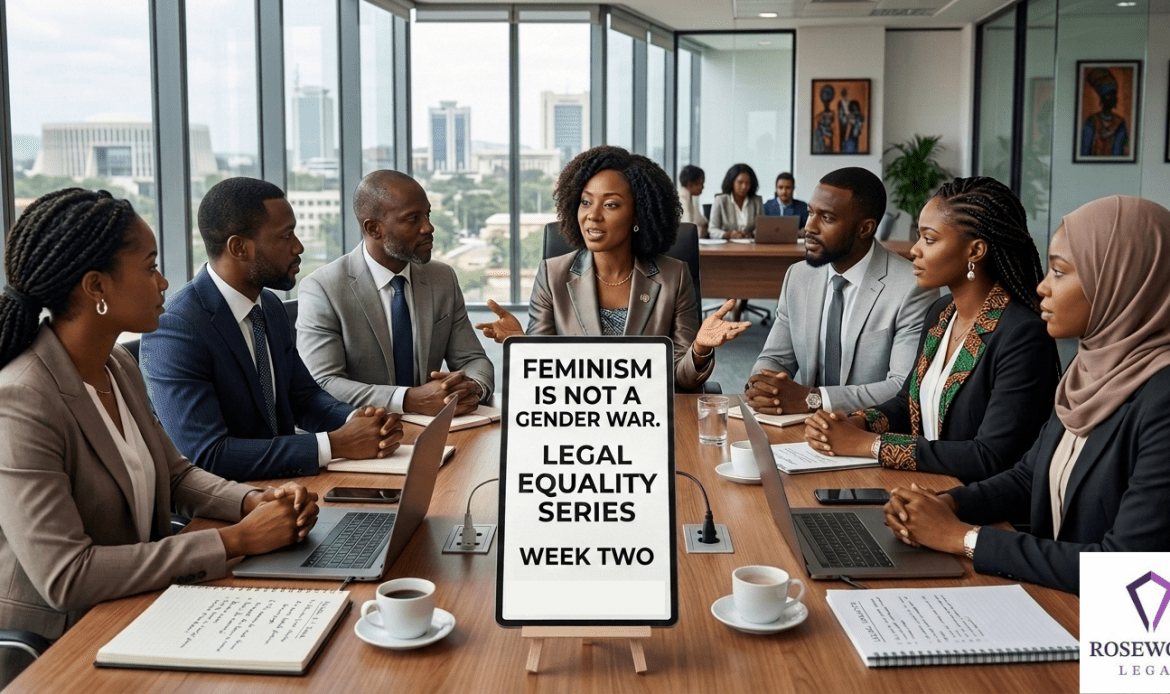
Few words in Nigerian public discourse provoke as much reaction as feminism. It is called foreign, anti-family, anti-men, and anti-culture. But stripped of the noise, feminism makes a far simpler claim: women are full legal and moral persons, entitled to the same dignity, protection, opportunities, and freedoms as men. That is not a gender war. It is the promise of the law.
As a law firm committed to access to justice and the rule of law, Rosewood Legal considers it necessary to address the confusion directly. When a concept rooted in legal equality is misrepresented and dismissed, real women lose real protections: in the workplace, in the home, before the courts, and in the halls of power.
Feminism is the political and philosophical commitment to the social, political, and economic equality of the sexes. It holds that women are full legal and moral persons. Much of that principle is already written into Nigerian law and into the international instruments Nigeria has ratified and is bound to honour.
Feminism is not foreign to Nigeria. Long before the word became controversial online, Nigerian women were resisting systems that treated them as invisible. The Aba Women’s Riots of 1929, led by thousands of market women against colonial policy, remain one of West Africa’s clearest examples of organised political resistance. Those women were not fighting men. They were fighting exclusion. That is the heart of feminism.
THE CONSTITUTIONAL FOUNDATION
Nigeria’s Constitution already rejects sex discrimination. Section 42 prohibits discrimination based on sex, while Section 17 affirms equality of rights, obligations, and opportunities before the law. At its simplest, feminism asks Nigeria to take those promises seriously.
Feminism and Misandry Are Not the Same Thing
The most damaging misconception about feminism is that it means hostility toward men. It does not. Misandry is prejudice against men. Feminism is a justice framework concerned with equality under law. Confusing the two is not harmless; it makes equality itself look dangerous.
The VAPP Act proves the point. Although it emerged from years of feminist advocacy, it protects all persons, including men. It criminalises rape regardless of the victim’s gender and addresses domestic violence, harmful traditional practices, stalking, and other forms of abuse. A movement that helps secure protections for everyone cannot honestly be described as a war against men.
This is not an accident of framing. It reflects the actual intellectual tradition of Nigerian feminism, which has consistently sought partnership, not conflict. What it has refused, and continues to refuse, is the suggestion that partnership requires women to accept subordination. Equal partnership and feminist principle are not in tension. They are the same thing.
When Social Media Becomes a Battlefield
Social media has amplified feminist voices, but it has also flattened the conversation. Algorithms reward outrage, not nuance. A single extreme post can be treated as proof of what all feminists believe, while serious legal and social questions disappear beneath insults, screenshots, and viral caricatures. The result is not merely online noise. It shapes political will, discourages women from speaking publicly, and weakens support for laws that protect them.
The Silencing Power of Labels
Words are not neutral. In discussions about gender equality, the choice of label can determine whether a conversation begins or ends before it starts. “Man-hater.” “Western import.” “Home-breaker.” “Radical.” These labels are routinely attached to
Nigerian women who publicly identify as feminists or speak openly about gender discrimination. They function not merely as insults but as instruments of social control, designed to raise the personal cost of advocacy high enough that silence begins to look safer.
Nigeria does not lack legal language on equality. It has constitutional protections, the VAPP Act, the Child Rights Act, the Cybercrimes Act, the National Gender Policy, CEDAW, and the Maputo Protocol. What it lacks is consistent enforcement and a public culture willing to take gender discrimination seriously. That is why the argument over feminism matters: if society misnames equality as hostility, the law’s promises remain paper promises.
The Conversation Nigeria Needs to Be Having
Nigeria is a country of extraordinary women. They are in its boardrooms and market squares, its courts and hospitals, its classrooms and construction sites, its legislative chambers and family homes. They build institutions, run businesses, raise children, argue cases, write legislation, and hold communities together, often without the legal, institutional, or social recognition their contributions deserve.
This is not an accident of history. It is the result of economic, legal, and cultural systems that have consistently undervalued and underprotected women’s contributions to national life.
Feminism names these systems. It traces their causes in law, custom, and institutional design. It does not do this out of hostility to men. It does it out of commitment to a principle already stated in the Constitution, recognised in statutes, and affirmed in international law: that every person should be treated as fully human before the law.
Feminism is not a demand that men lose. It is a demand that the law mean what it says. Equality does not need an enemy; it needs honesty, enforcement, and the courage to name injustice without turning those who name it into the problem. That is the conversation Nigeria should be having. And it is the conversation Rosewood Legal will continue to advance.
Author

Chiamaka Sophia Okpara-John
Trainee Associate
Rosewood Legal
Co-author

Lateefat Omotomilola Hakeem-Bakare
Principal Partner
Rosewood Legal
Published on Thursday, July 2, 2026
Notes / Authorities
1. Constitution of the Federal Republic of Nigeria 1999 (as amended), especially section 42 on freedom from discrimination and section 17 on equality of rights, obligations, and opportunities before the law.
2. Violence Against Persons (Prohibition) Act 2015, which prohibits violence in private and public life and provides protection, remedies, and penalties for offences including rape, domestic violence, harmful traditional practices, stalking, intimidation, and related forms of abuse.
3. Child Rights Act 2003, which provides for the rights and protection of the Nigerian child, including protection from discrimination, child marriage, exploitation, harmful practices, and abuse.
4. Cybercrimes (Prohibition, Prevention, etc.) Act 2015, as amended by the Cybercrimes (Prohibition, Prevention, etc.) (Amendment) Act 2024, including provisions relevant to cyberstalking, harmful online communication, identity-related offences, and technology-facilitated abuse.
5. National Gender Policy 2021–2026, Nigeria’s strategic policy framework for gender equality, women’s empowerment, social inclusion, and the mainstreaming of gender equity across national development.
6. Convention on the Elimination of All Forms of Discrimination Against Women (CEDAW), ratified by Nigeria, which requires state parties to eliminate discrimination against women in law, policy, and practice.
7. Protocol to the African Charter on Human and Peoples’ Rights on the Rights of Women in Africa, commonly known as the Maputo Protocol, ratified by Nigeria, which affirms women’s rights to dignity, equality, political participation, protection from violence, and protection from harmful practices.
8. African Charter on Human and Peoples’ Rights, which forms part of Nigeria’s regional human rights obligations and supports the broader equality and dignity framework referenced in this article.
9. The Aba Women’s Riots, also known as the Women’s War of 1929, are referenced as historical context for women’s organised political resistance in colonial Nigeria.